Hitting the open road in a motorhome is one of the best ways to experience Australia.
Whether you are heading up to the sun-drenched Queensland coast, exploring the rugged beauty of the outback, or navigating the winding roads of the Victorian High Country, the freedom of having your home on wheels is unmatched.
However, that freedom relies entirely on the reliability of your vehicle. A breakdown on a remote stretch of highway is not just an inconvenience; it can be a costly and stressful ordeal that ruins a hard-earned holiday.
Before you turn the key and pull out of the driveway, a thorough pre-trip inspection is essential.
This guide provides a comprehensive, step-by-step motorhome safety checklist tailored specifically for Australian conditions.
From under-the-hood mechanical checks to ensuring your living quarters are secure and compliant with local fire safety regulations, we cover everything you need to know to travel with confidence.
This is not just a quick glance at the tyres. This is the ultimate guide to ensuring your motorhome is mechanically sound, legally compliant, and perfectly prepared for the harsh realities of Australian touring.
1. The Under-the-Hood Mechanical Check
The foundation of a safe road trip is a mechanically sound vehicle.
Motorhomes are heavy vehicles that work hard, especially when fully loaded with water, gear, and passengers for a long trip.
They place immense strain on their engines, transmissions, and cooling systems.
Checking your vital fluids and filters is the first and most critical step in your pre-trip routine.
Modern diesel engines, which power the vast majority of motorhomes in Australia (such as the Fiat Ducato, Renault Master, Mercedes Sprinter, and Iveco Daily), are highly reliable but demand strict maintenance. They rely heavily on clean air and uncontaminated fuel to operate efficiently.
Essential Engine Fluids
Start by checking the vital fluids on a level surface when the engine is cold.
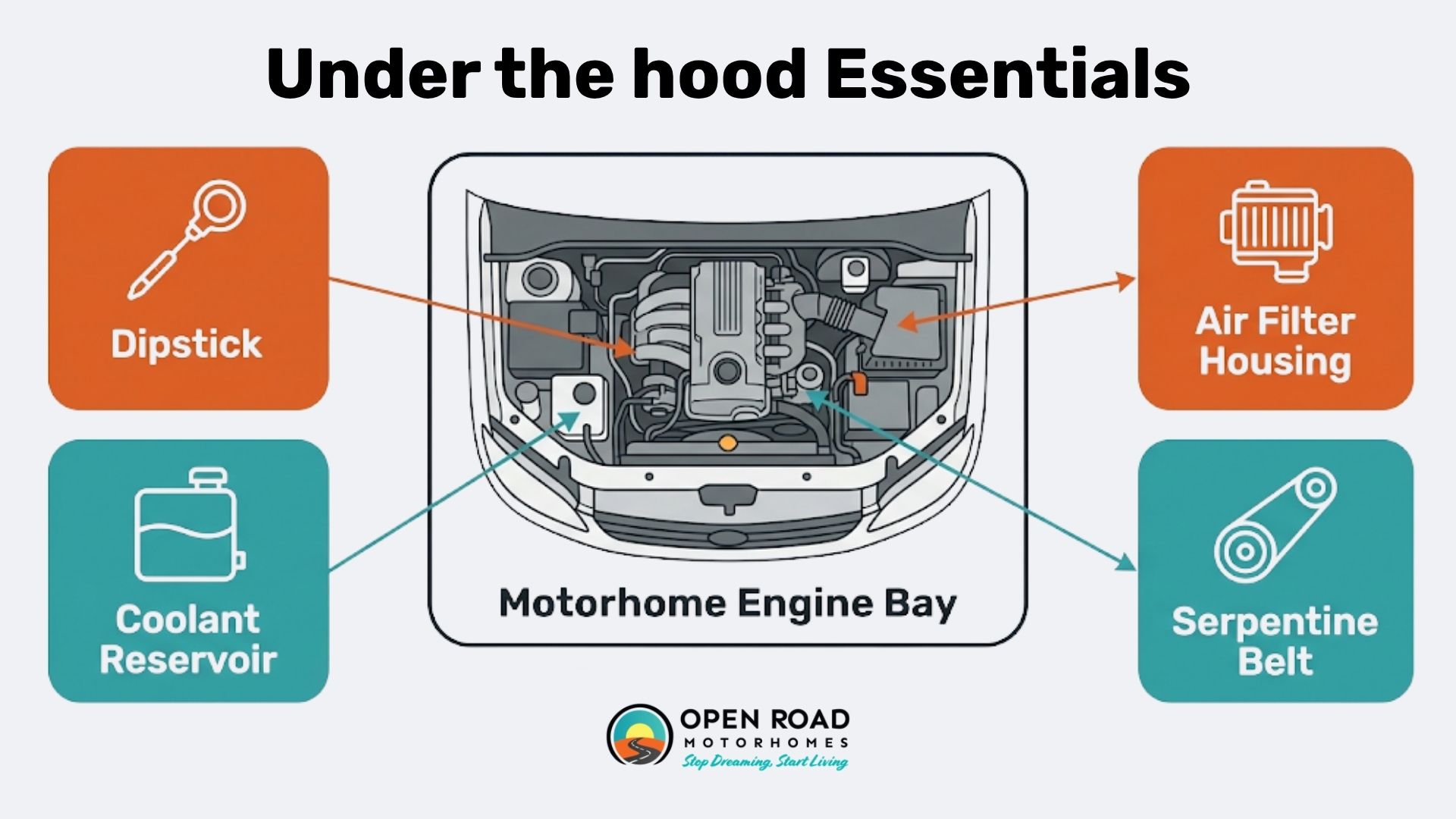
- Engine Oil: Pull the dipstick, wipe it clean, reinsert it fully, and pull it out again. Ensure the oil level is sitting comfortably between the minimum and maximum markers. If your engine oil is excessively dark, gritty, or smells burnt, it is time for a change. Never overfill the oil, as this can cause catastrophic engine damage in modern diesels.
- Coolant: Check the coolant reservoir (never open a hot radiator cap). The level should be between the MIN and MAX lines. Ensure the coolant is clean and brightly coloured (usually red, green, or blue). Mixing different types of coolant can cause it to gel and block the cooling system, leading to rapid overheating.
- Brake Fluid: Check the master cylinder reservoir. The fluid should be clear or slightly yellow, not cloudy or dark brown. A low brake fluid level could indicate worn brake pads or a leak in the system.
- Power Steering Fluid: Ensure the fluid is at the correct level. A whining noise when turning the steering wheel is a classic sign of low power steering fluid.
Filters and Belts
A dusty or clogged air filter will significantly reduce performance, increase fuel consumption, and cause the engine to run hot.
Inspect your air filter; if you can see visible dirt buildup or if you have recently travelled on unsealed roads, replace it.
Similarly, ensure your fuel filter is in good condition. Australian outback fuel stations can sometimes supply contaminated diesel, which can destroy common-rail diesel injectors.
If you are travelling into remote areas, carrying spare air and fuel filters is a smart insurance policy.
Finally, take a high-powered torch and inspect the engine bay for any obvious leaks, frayed belts, or cracked hoses. A failed serpentine belt will disable your alternator, water pump, and power steering all at once, which is a situation you want to avoid at all costs.
2. Tyres, Suspension, and Exterior Walkaround
Your tyres are the only point of contact between your heavy motorhome and the road.
A blowout at highway speeds is incredibly dangerous, making tyre maintenance a non-negotiable part of your safety checklist.
Motorhomes often sit idle in driveways for months at a time, which accelerates tyre degradation.
UV exposure and lack of movement can cause the rubber compounds to dry out and crack, long before the tread wears down.
Comprehensive Tyre Inspection
Check the tyre pressure on all wheels, including the spare, when the tyres are cold (before you have driven more than a few kilometres).
The correct pressure will depend on your vehicle’s weight and the terrain you are tackling. Always refer to the tyre placard inside the driver’s door jamb or the owner’s manual for the correct pressures.
Inspect the tread depth to ensure it is well above the legal minimum of 1.5mm across the entire face of the tyre.
Look closely at the sidewalls for any signs of cracking, dry rot, or bulging. As a general rule in the RV industry, tyres should be replaced every five to six years, regardless of how much tread is left, due to age-related degradation.
Suspension and Undercarriage
While you are looking at the wheels, inspect the suspension components. Motorhomes carry a lot of weight high up, which places immense stress on shock absorbers and leaf springs. Look for weeping fluid on the shock absorbers, which indicates a blown seal. Check the leaf springs for any visible cracks or flattening.
The 360-Degree Exterior Walkaround
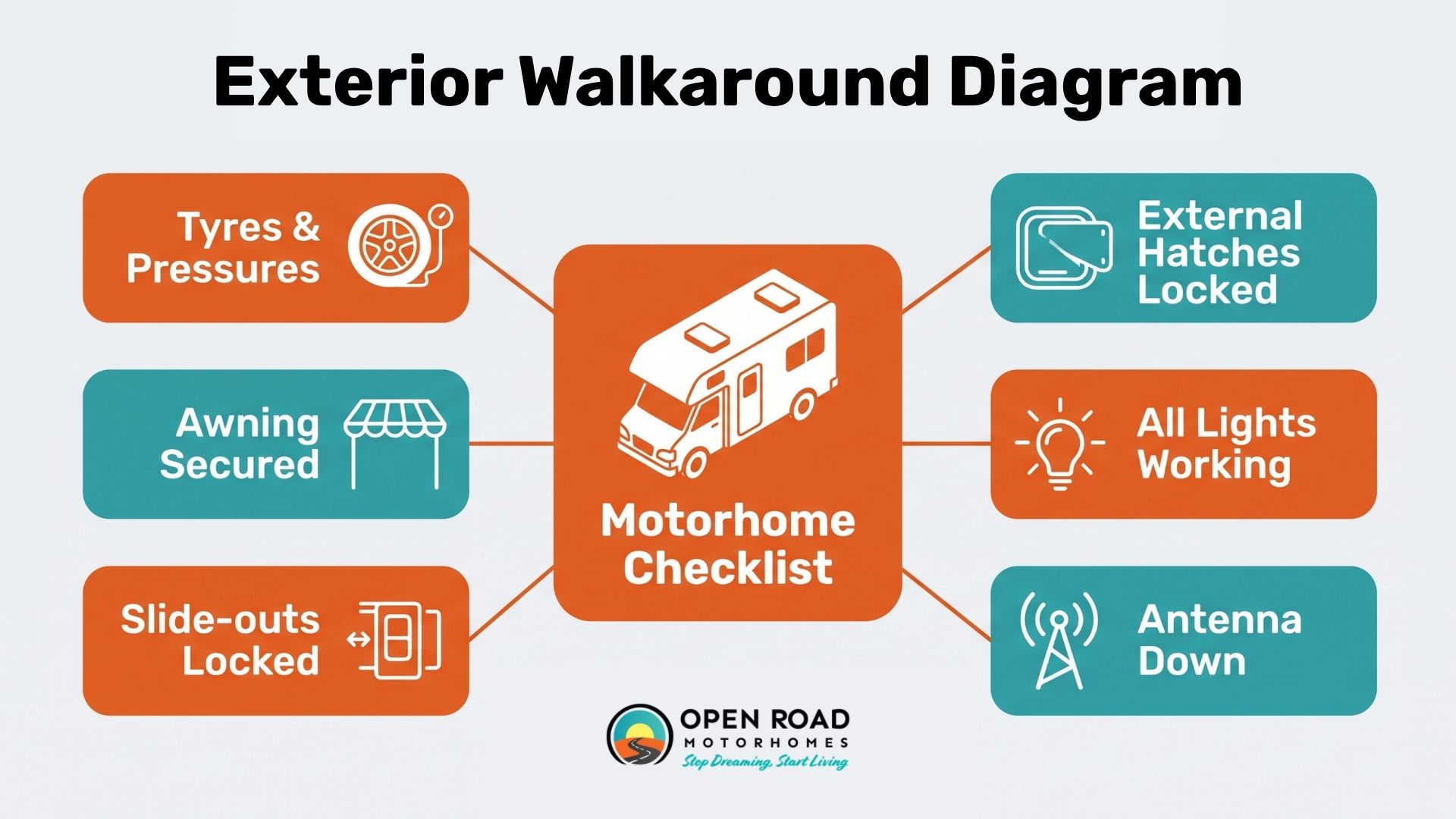
Once the undercarriage is cleared, perform a slow, methodical walkaround of the exterior.
- Slide-outs: Ensure all slide-outs are fully retracted, locked, and the travel bars (if applicable) are in place.
- Awnings: Ensure the awning is rolled up tightly and the travel locks are engaged. A loose awning can unfurl at highway speeds, causing severe damage.
- External Hatches: Check that all external storage compartment doors are securely locked. An open hatch can easily be ripped off by a passing truck.
- Roof: If safe to do so, inspect the roof. Ensure the TV antenna is wound down, roof vents are closed and locked, and solar panels are secure.
- Lighting: Test all exterior lighting, including headlights, high beams, brake lights, indicators, and clearance lights. Have a second person stand behind the vehicle to confirm they are functioning correctly.
3. Gas, Electrical, and Water Systems
The living quarters of a motorhome require just as much attention as the engine.
The combination of LPG gas, 12V electrical systems, and freshwater storage means there are several critical systems to secure before hitting the highway.
Securing the Interior Cabin
Everything inside the motorhome must be tied down or packed away.
Motorhomes experience significant vibration and movement on the road, turning loose items into dangerous projectiles.
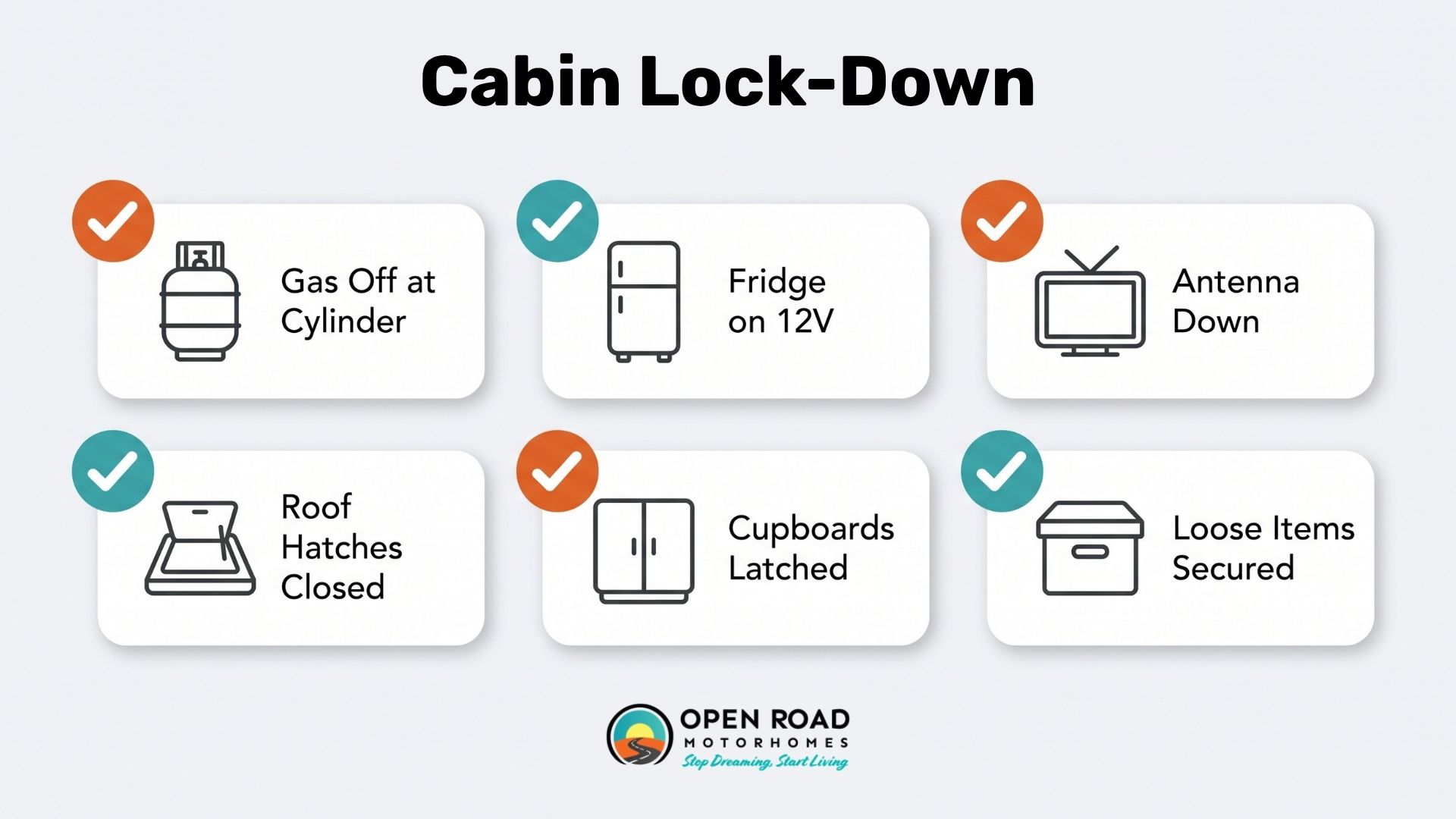
Ensure all cupboards, overhead lockers, and drawers are securely latched.
Pay special attention to the refrigerator door; ensure the travel lock is engaged so your food does not spill out onto the floor around the first corner.
Switch the refrigerator to 12V DC power (if it is a 3-way absorption fridge) so it remains cool while you drive, drawing power from the vehicle’s alternator rather than using gas.
Ensure all roof hatches, skylights, and windows are closed tight to prevent dust ingress and wind damage.
LPG Gas Safety and Compliance
LPG gas is highly flammable and poses a significant risk if not managed correctly.
Ensure your gas cylinders are turned off at the valve before you start driving.
It is illegal and highly dangerous in Australia to travel with gas appliances running, including running your fridge on gas while in transit.
Check the date stamped on the collar of your LPG cylinders.
In Australia, gas cylinders must be tested and re-certified every ten years. A cylinder that is out of date cannot be legally refilled at a service station.
Furthermore, ensure the gas cylinders are stored in their dedicated, externally vented compartment, and never inside the living area.
Electrical and Solar Systems
Test your battery systems using a multimeter or your onboard battery management system.
Your house battery (whether AGM, Gel, or Lithium) should show a healthy charge to ensure your lights, water pump, and fridge will work when you pull up to camp.
- AGM/Gel Batteries: Should rest at around 12.6V to 12.8V when fully charged.
- Lithium (LiFePO4) Batteries: Will typically rest higher, around 13.3V to 13.6V.
Check your solar controller to ensure the panels are actively charging the batteries.
Inspect the 240V extension lead (15-amp) you use to plug into caravan parks; ensure there are no cuts, exposed wires, or bent pins.
Water Systems
Run the water pump briefly to ensure the freshwater system is pressurised and there are no obvious leaks under the sink, in the bathroom, or around the hot water system.
Before a long drive, consider how much water you need to carry. Water is heavy (1kg per litre).
If you are driving on sealed highways between caravan parks with town water, you do not need to carry a full 100-litre tank, which saves fuel and wear on the vehicle.
However, if you are heading off-grid, fill your freshwater tanks completely and ensure your grey water and black water (toilet) cassettes are empty before departure.
4. Motorhome Fire Safety in Australia
Fire safety is a critical component of motorhome travel.
The compact space, combined with cooking facilities, high-current electrical systems, and LPG gas, means a fire can escalate in a matter of seconds.
Australian regulations are strict regarding fire safety equipment in recreational vehicles, and compliance is non-negotiable.
Fire Extinguisher Requirements (ADR 44/01)
Under the Australian Design Rules (ADR 44/01), motorhomes must be fitted with at least one fire extinguisher with a minimum 5B rating.
This extinguisher must be mounted in the living space, in a highly visible and accessible location near an exit, and no higher than 1.2 metres from the floor.
An ABE dry powder extinguisher is the recommended choice for motorhomes. The ABE rating means it is effective against:
- Class A: Combustible materials (wood, paper, fabrics, upholstery).
- Class B: Flammable liquids (petrol, diesel).
- Class E: Electrical fires (12V wiring, inverters, solar controllers).
Check the pressure gauge on your extinguisher regularly; the needle must be in the green zone.
Extinguishers should be professionally serviced or replaced every five years.
Fire Blankets and Smoke Alarms
In addition to an extinguisher, a fire blanket should be mounted near the cooktop.
Fire blankets are the safest and most effective way to quickly smother oil or grease fires (Class F) without discharging a messy powder extinguisher throughout the cabin.
Smoke alarms are vital life-saving devices.
Recent legislative changes in Queensland mandate that all newly registered or transferred caravans and motorhomes must have a photoelectric smoke alarm with a 10-year non-removable battery installed on the ceiling.
By January 2027, this will apply to all registered RVs in Queensland. Regardless of your home state, fitting a high-quality photoelectric smoke alarm is a standard all travellers should adopt immediately.
| Fire Safety Equipment | Recommended Type | Ideal Location |
| Fire Extinguisher | 1kg or 2.5kg ABE Dry Powder | Mounted securely near the main exit door |
| Fire Blanket | Minimum 1m x 1m | Mounted on the wall near the kitchen cooktop |
| Smoke Alarm | Photoelectric (10-year lithium battery) | Ceiling of the living or sleeping area |
| Carbon Monoxide Alarm | Certified to EN50291 or UL2034 | Wall-mounted in the living area |
5. On-the-Road Safety Tips for Big Rigs
Driving a motorhome is vastly different from driving a standard passenger car.
The sheer size, height, and weight of the vehicle require a fundamental change in driving habits to ensure safety on the road.
Braking Distance and Following Gaps
A fully loaded motorhome can weigh anywhere from 3.5 to 5 tonnes, or more.
This massive weight means the vehicle cannot stop quickly in an emergency. Always leave significantly more distance between your motorhome and the vehicle in front of you.
A good rule of thumb is to double your normal following distance, allowing at least a four to five-second gap.
Managing Tail Swing and Height
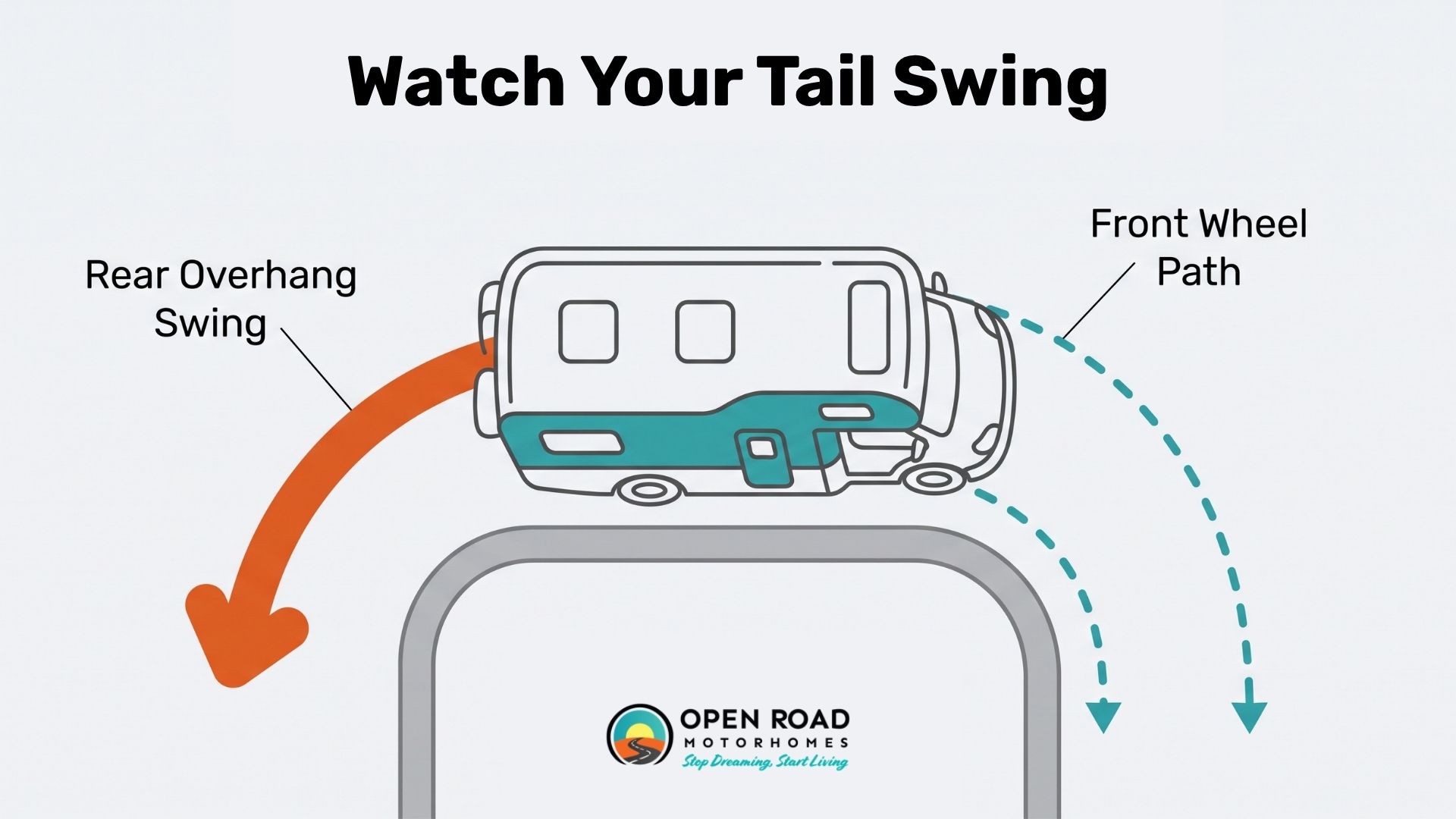
When navigating corners, roundabouts, or tight fuel stations, be highly aware of tail swing.
Because the rear axle acts as a pivot point, as you turn the steering wheel to the right, the long rear overhang of the motorhome will swing out to the left.
This can easily clip parked cars, fuel bowsers, or street signs if you do not take the corner wide enough.
Height awareness is equally critical.
Know the exact height of your motorhome in metres (including the air conditioner and TV antenna) and write it on a sticky note placed on the dashboard.
Watch carefully for low bridges, overhanging tree branches, and drive-through height limits.
Wildlife and Night Driving
Avoid driving at dawn, dusk, and during the night whenever possible in rural and regional Australia.
These are the peak times for wildlife activity, particularly kangaroos, emus, and stray cattle.
A high-speed collision with a large animal can cause catastrophic damage to a motorhome, disable the radiator, and put the occupants at serious risk.
Plan your driving hours during the daylight and aim to be set up at your campsite well before the sun goes down.
Need a Professional Eye? Book a Pre-Trip Service
While a personal walkaround and pre-trip checklist are essential, nothing beats the peace of mind that comes from a professional mechanical and habitation inspection.
If you are planning a major trip, the expert team at Open Road Motorhomes can help.
Our Glendenning workshop in Sydney provides comprehensive motorhome servicing, maintenance, and repairs.
From engine servicing and electrical diagnostics to suspension checks, solar upgrades, and roof re-sealing, our experienced technicians understand the unique systems used in European and Japanese motorhomes.
Do not leave your safety to chance; contact us today to book your pre-trip service and hit the road with total confidence.
Frequently Asked Questions (FAQs)
What should I check on my motorhome before a long trip?
You should check all vital engine fluids (oil, coolant, brake fluid), tyre pressures and tread depth, exterior lights, and ensure all slide-outs and awnings are secured. Inside, turn off the LPG gas at the cylinder, secure all loose items, switch the fridge to 12V power, and ensure your smoke alarm and fire extinguisher are in good working order.
Do I need a fire extinguisher in my motorhome in Australia?
Yes. Under Australian Design Rules (ADR 44/01), motorhomes must be fitted with at least one readily accessible fire extinguisher (minimum 5B rating) mounted in the living area. An ABE dry powder extinguisher is highly recommended as it covers combustible materials, flammable liquids, and electrical fires.
Is it legal to travel with the gas fridge running in Australia?
No, it is highly dangerous and illegal to travel with LPG gas appliances running. You must turn off the gas at the cylinder valve before driving. To keep your fridge cold while travelling, switch it to the 12V DC setting, which draws power from the vehicle’s alternator.
How often do motorhome LPG gas bottles need to be tested?
In Australia, LPG gas cylinders must be professionally tested and re-certified every 10 years. The test date is stamped on the collar of the cylinder. Service stations will refuse to refill a cylinder that is past its 10-year expiration date.