A weekend away forgives a lot. You can survive two nights with a flat battery, a leaking hose fitting and no way to level the van on a sloping site. A four-week run up the coast, or a crossing of the Nullarbor, does not forgive anything.
Long-distance travel changes what counts as an accessory. Gear stops being a convenience and starts being infrastructure. The kit that matters is the kit that keeps power, water, weight and communications under control for weeks at a time, a long way from a hardware store.
This guide covers what actually earns its place on a long trip, what it weighs, and what most first-time travellers buy and never use.
What accessories do you actually need for long-distance motorhome travel?
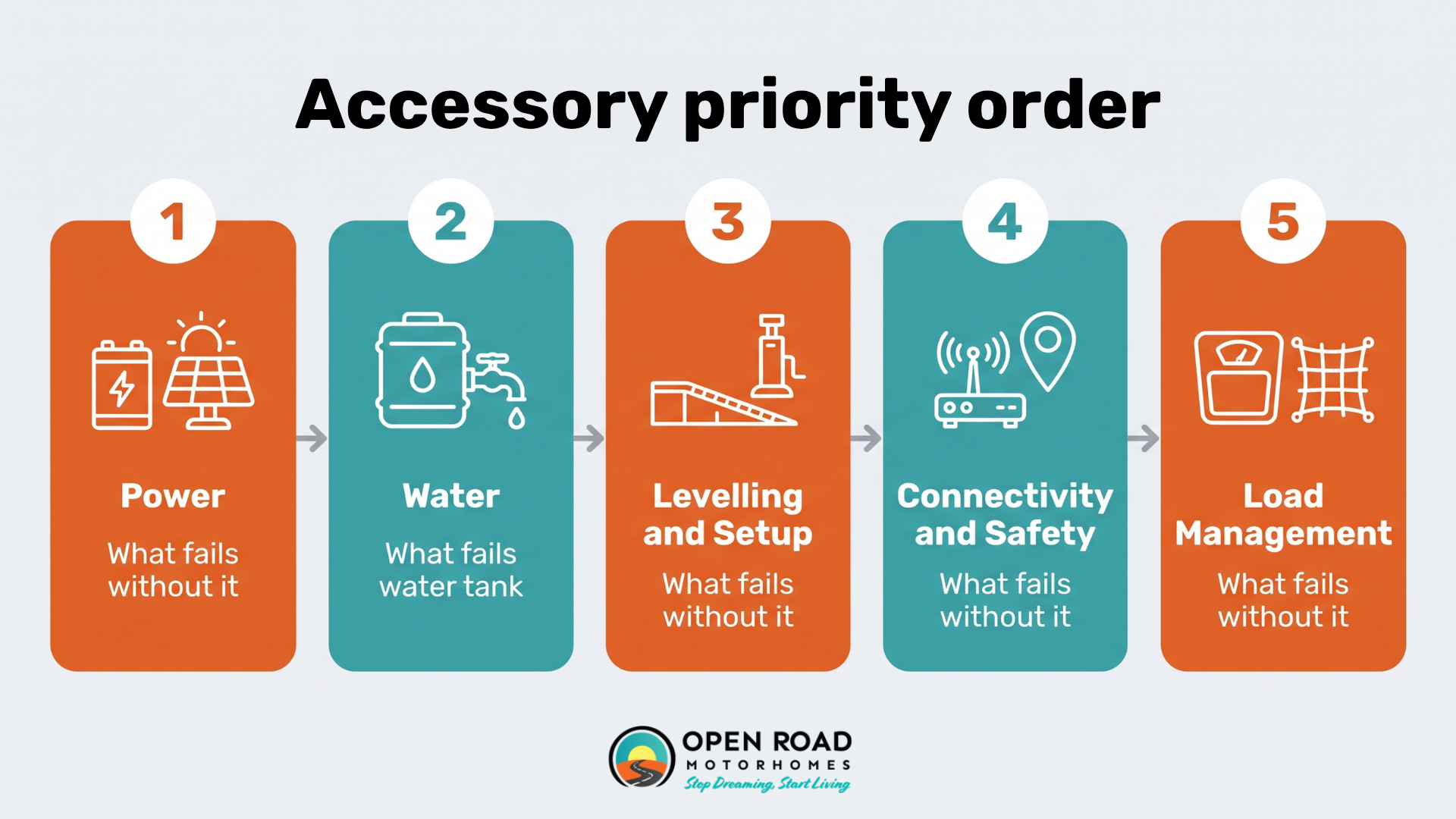
For trips beyond about two weeks, you need gear across five systems: power, water, levelling and setup, connectivity and safety, and load management. Everything else is comfort.
Most accessory guides hand you a list of thirty items with no sense of priority. That is how people end up 300kg overweight with a satellite phone they cannot operate and no spare water hose. A better approach is to work through the five systems in order, because each one has a hard failure point that ends a trip.
| Fire Safety Equipment | Recommended Type | Ideal Location |
|---|---|---|
| Fire Extinguisher | 1kg or 2.5kg ABE Dry Powder | Mounted securely near the main exit door |
| Fire Blanket | Minimum 1m x 1m | Mounted on the wall near the kitchen cooktop |
| Smoke Alarm | Photoelectric (10-year lithium battery) | Ceiling of the living or sleeping area |
| Carbon Monoxide Alarm | Certified to EN50291 or UL2034 | Wall-mounted in the living area |
Work top to bottom. Add comfort items only once the five systems are covered and you still have payload left.
How much of this you need to add depends on the vehicle underneath it. Power and water capacity are far cheaper to get right at purchase than to retrofit later, so these five systems are the specification worth comparing when you are looking at motorhomes for sale or campervans for sale.
Power: the system that ends most trips early
Power is the first thing to plan and the most expensive thing to fix on the road. Long-distance travel means days between powered sites, and a 12V system sized for weekend caravan parks will not carry a fridge through three overcast days.
How much battery do you need for off-grid travel?
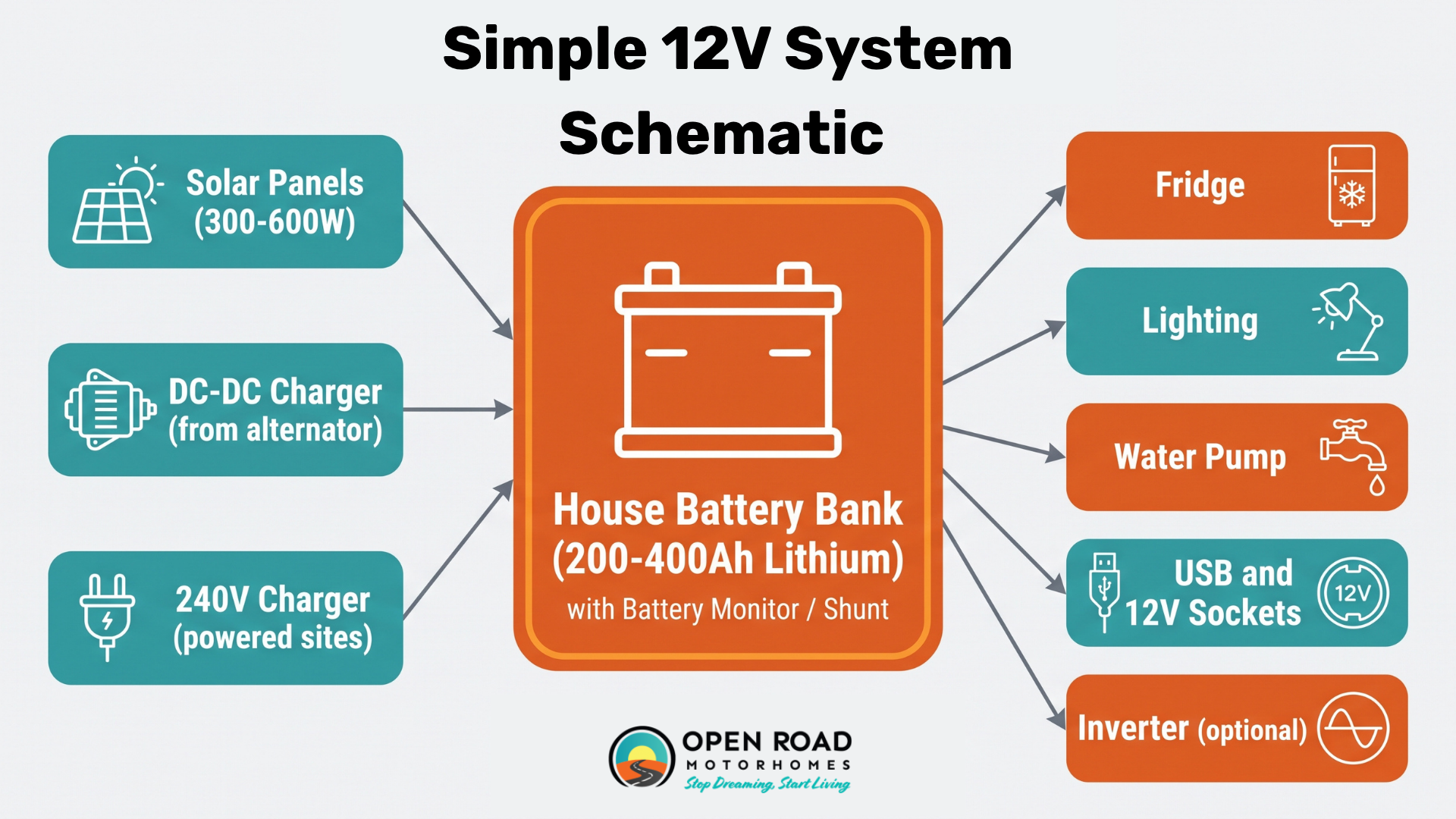
Most long-distance travellers need between 200Ah and 400Ah of usable lithium capacity, depending on fridge size and whether they run air conditioning or an inverter.
Work it out rather than guessing. Add up the daily draw of everything you run, then multiply by the number of days you want to sit still without sun.
Worked example: A 90-litre compressor fridge drawing an average of 3A over 24 hours uses roughly 72Ah per day. Add 10Ah for lighting, 15Ah for water pump, charging and fans, and you are near 100Ah daily. Two days of autonomy with no solar input means 200Ah usable.
Lithium delivers close to its full rated capacity. Lead acid and AGM should not be discharged below about 50 percent without shortening their life, so a 200Ah AGM bank gives you roughly 100Ah of usable power at nearly double the weight.
| Battery type | Usable capacity (200Ah rated) | Approx. weight | Best suited to |
|---|---|---|---|
| AGM | ~100Ah | 55 to 60kg | Shorter trips, mostly powered sites |
| Lithium (LiFePO4) | ~180 to 200Ah | 22 to 30kg | Extended off-grid touring |
The weight difference is the point. Swapping 60kg of AGM for 25kg of lithium frees up 35kg of payload for water, tools or food.
Solar, DC-DC charging, or both?
Both. Solar covers stationary days, DC-DC charging covers driving days, and long-distance travel involves plenty of each.
- Solar panels: 300W to 600W suits most motorhomes. Roof space usually caps this before budget does. Expect roughly 4 to 5 usable hours of generation per day in good Australian conditions, less in winter or under tree cover.
- DC-DC charger: Charges the house battery properly from the alternator while driving. Modern vehicles with smart alternators will not charge a house bank correctly without one.
- Portable solar blanket: Lets you park in shade and put the panel in the sun. Genuinely useful in the tropics, where roof-mounted panels bake and shade is non-negotiable.
- Battery monitor with a shunt: A voltage reading alone tells you almost nothing on lithium. A shunt-based monitor shows amps in, amps out and true state of charge.
The battery monitor is the cheapest item in that list and the one that changes behaviour most. Once you can see the fridge pulling 3.2A, you start managing consumption instead of hoping.
Battery, solar and charging components have to be matched to each other and to your vehicle’s alternator. Mismatched components are the most common cause of a system that looks right on paper and underperforms on the road. Our workshop handles solar diagnostics for motorhomes if your panels are not delivering what they should, and motorhome electrical repairs for battery, charging and 12V wiring work.
Water: how you extend your range
Water capacity, not fuel, is what limits how long you can stay put. Fuel gets you to the next town. Water decides whether you want to go.
Most motorhomes carry between 80 and 150 litres of fresh water. At realistic usage of 15 to 20 litres per person per day including showers and dishes, two people on 100 litres have roughly three days before a refill.
Water accessories that earn their place:
- Drinking-water hose (food-grade, 10 to 15m): A garden hose taints the tank. Carry a dedicated white or blue potable hose and keep it in its own sealed bag, never on the ground.
- Inline water filter: Bore water and remote town supplies vary enormously in taste and sediment. A carbon inline filter at the tank inlet protects the tank and the pump.
- Hose fitting kit: Tap fittings across Australian caravan parks, showgrounds and roadhouses are inconsistent. A small kit of adaptors saves a lot of frustration.
- Collapsible water carrier (10 to 20L): Lets you top up from a tap you cannot park next to. Also your backup if the tank is contaminated.
- Greywater hose and portable greywater tank: Increasingly required rather than optional. Many councils and free camps now prohibit discharging greywater onto the ground.
- Cassette or tank chemicals plus spare cassette seals: Seals perish. Carry spares, because you will not find them in a town of 400 people.
Fill water before you need it, not when you are low. A tap you can reach today is worth more than a tap you might reach tomorrow.
Buy the seals, adaptors and spare hose before you leave, not when you need them. If your pump, tank or plumbing is not holding up, our service and repairs team can sort it before you go rather than in a caravan park.
Dump points and greywater on the road
Plan dumps around your route in advance using a dump point locator app, and never assume a free camp has facilities. Regional councils open and close facilities without notice, and popular sites are frequently at capacity in peak season. Carrying a portable greywater tank means a full or closed dump point delays you rather than stops you.
Levelling, setup and living space
This is where long trips diverge sharply from weekends. Setting up twenty times over four weeks makes speed and repeatability worth real money.
| Accessory | Why it matters on a long trip | Approx. weight |
|---|---|---|
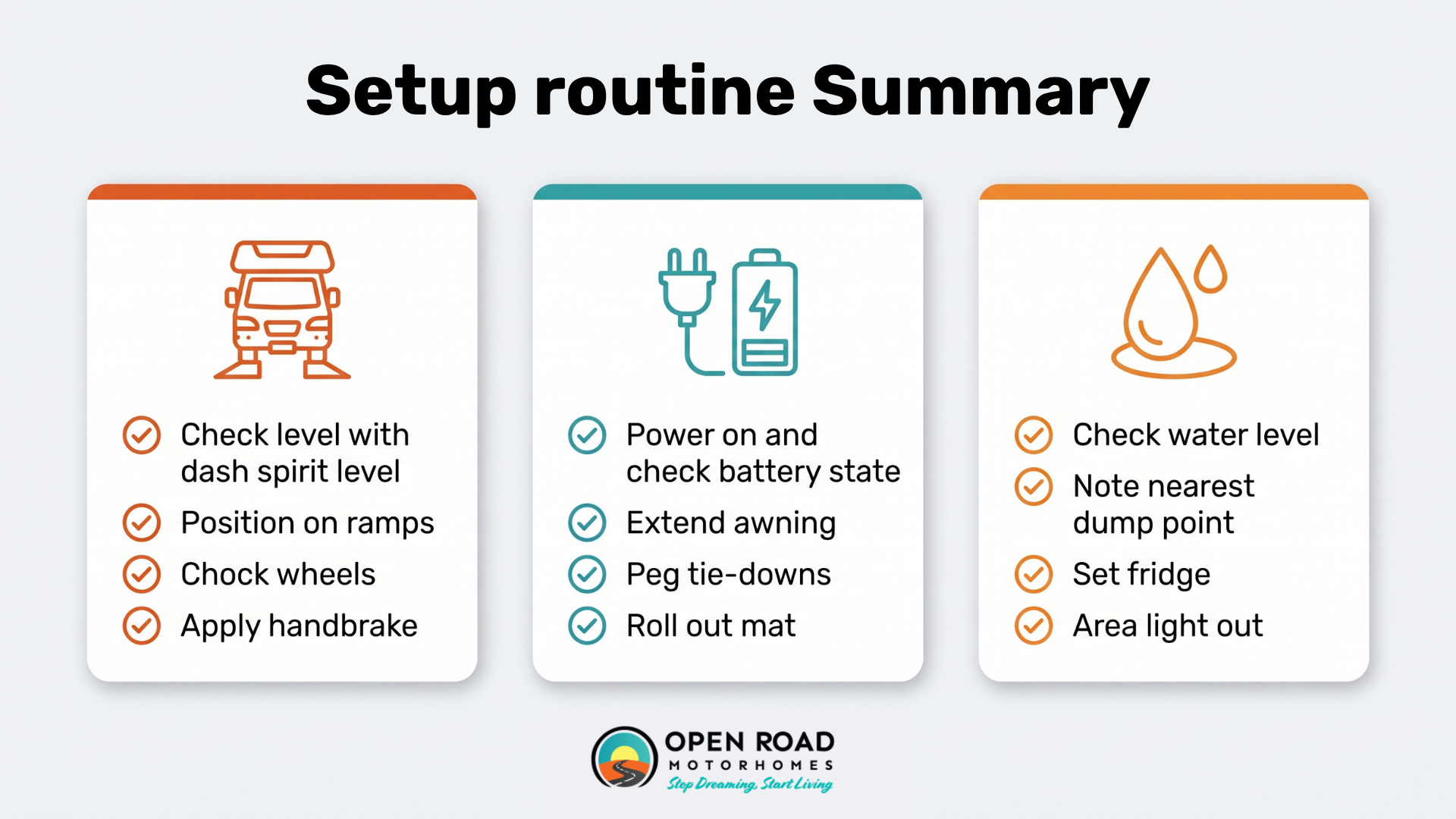
| Levelling ramps or blocks | Absorption fridges need level to work; all fridges last longer level | 3 to 6kg |
| Spirit level (permanent, dash-mounted) | Removes guesswork, speeds up every single setup | Negligible |
| Wheel chocks | Safety on any slope, required at many sites | 1 to 3kg |
| Outdoor mat | Keeps sand and red dust out of the van, the single biggest cleanliness factor | 4 to 8kg |
| Awning and tie-down kit | Shade and weather protection; the tie-downs are what stop awning damage in wind | 5 to 10kg |
| LED strip or area light | Lets you use the outdoor space after dark without draining much power | Negligible |
| Folding outdoor furniture | You will spend more time outside than inside | 8 to 15kg |
| Ventilation fan (roof) | Manages condensation and heat, reduces reliance on air conditioning | Fitted |
Two items on that list are underrated. The outdoor mat does more to keep a motorhome liveable over a month than any cleaning product. The awning tie-down kit prevents the most common and most expensive damage claim in Australian touring, which is an awning caught by a gust while nobody is watching.
None of this needs to be expensive. Spend where the failure is costly, which is the awning tie-downs, and buy the rest to whatever standard suits your budget.
Connectivity and safety in remote areas
Mobile coverage across regional Australia is far patchier than coverage maps suggest, and a phone with no bars is not a safety plan.
- External antenna and mobile signal booster: Turns one marginal bar into a usable connection at the edges of coverage. The most practical connectivity upgrade for most travellers.
- Satellite messenger or personal locator beacon (PLB): A PLB is for life-threatening emergencies and is a one-way alert. A satellite messenger allows two-way texting and check-ins. Anyone crossing the Nullarbor, the Gibb River Road, or the inland routes should carry one of the two.
- UHF CB radio: The working channel of the road. Road trains, oversize escorts and other travellers all use it. On single-lane outback roads it is how you get told a truck is coming through.
- Tyre pressure monitoring system (TPMS): A slow leak at highway speed on a heavy vehicle is a serious event. TPMS gives you warning while it is still a repair rather than a rescue.
- Dash camera: Useful for insurance, particularly in incidents involving wildlife or unsealed roads.
A PLB is not a substitute for a communications plan. Tell someone your route and your expected check-in times before you leave the phone range.
For route planning and finding other travellers on the road, our guide to online maps that connect motorhome owners across Australia covers the tools worth having loaded before you leave coverage.
Recovery and repair gear
Carry the gear that matches the roads you intend to drive, not the roads you imagine driving.
For sealed-road touring: a quality tyre repair kit, a 12V compressor, jumper leads or a lithium jump starter, basic tools, cable ties, self-amalgamating tape, spare fuses and spare globes.
For unsealed and remote routes, add: a second spare tyre where the vehicle allows, recovery tracks, a shovel, a rated recovery strap and rated recovery points, and a comprehensive spares kit including belts and hoses.
A 12V compressor deserves specific mention. Dropping tyre pressures for corrugated roads and reinflating for the bitumen reduces tyre damage, improves comfort and cuts fatigue. Without a compressor you cannot do it.
How much weight do motorhome accessories add?
A typical long-distance accessory fit-out adds between 150kg and 400kg once water, tools, food and recovery gear are counted, which is enough to put many motorhomes over their legal limit.
This is the section most accessory guides skip entirely, and it is the one that has legal and insurance consequences.
Your motorhome has a Gross Vehicle Mass (GVM), which is the maximum legal loaded weight. Payload is GVM minus the vehicle’s tare (empty) weight. On many Australian motorhomes the payload sits between 400kg and 800kg, and it disappears faster than people expect.
| Load item | Typical weight |
|---|---|
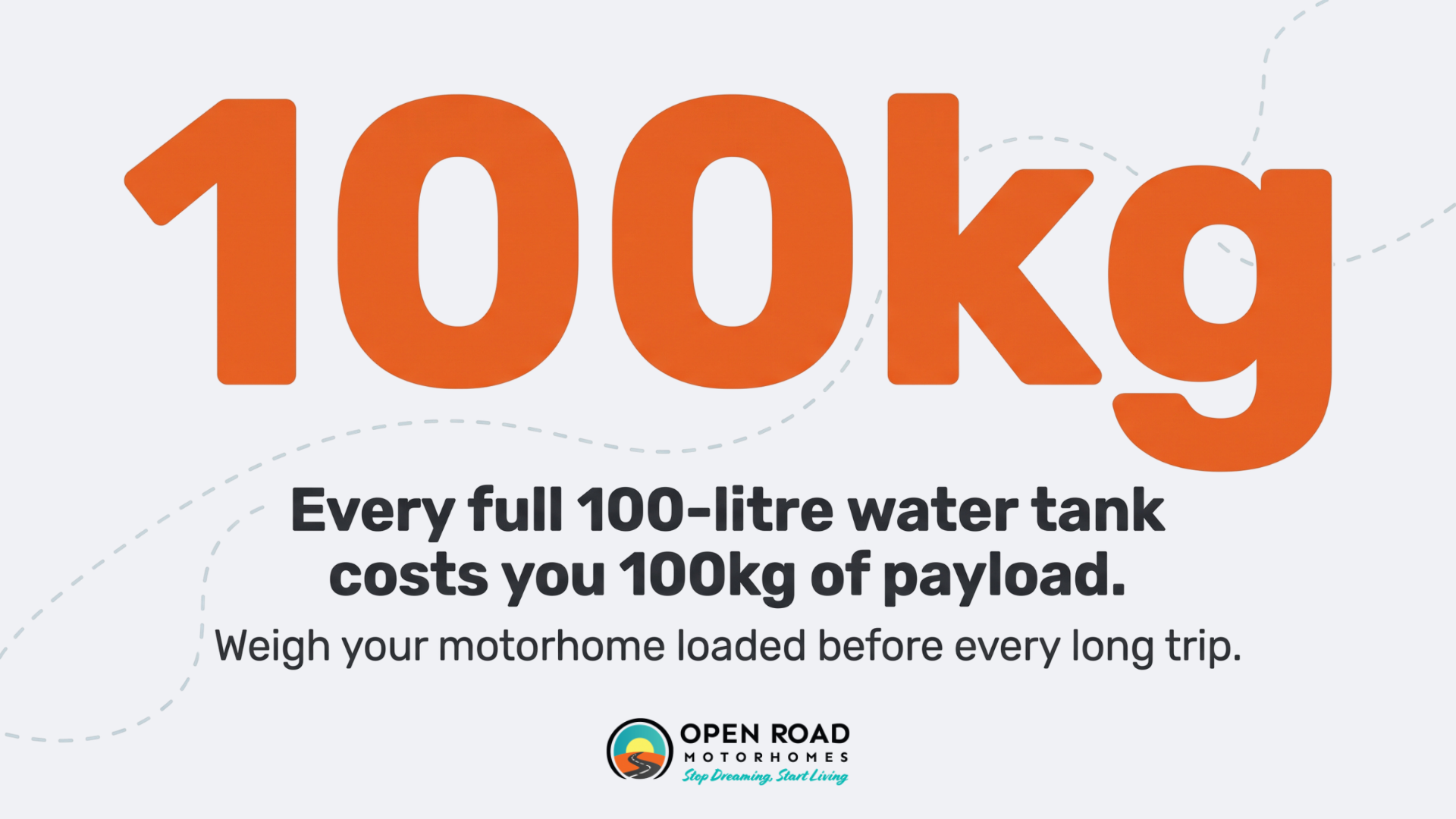
| Fresh water (100L) | 100kg |
| Two adults | 150 to 170kg |
| Lithium battery upgrade (200Ah) | 25 to 30kg |
| Solar panels and wiring (400W) | 25 to 30kg |
| Food, clothing and bedding for four weeks | 60 to 90kg |
| Tools, spares and recovery gear | 30 to 60kg |
| Outdoor furniture, mat and awning gear | 20 to 35kg |
| Full gas bottles (2 x 9kg) | 40kg |
| Running total | 450 to 555kg |
That total does not include a generator, a second spare wheel, a bike rack or bikes, or a full toilet cassette. Add those and a 600kg payload is gone.
Three practical rules:
- Weigh the vehicle loaded, at a public weighbridge, before a long trip. Loaded and ready to travel, with full water and full gas. Guessing is not a defence.
- Check axle loads, not just total weight. It is possible to be under GVM and over on the rear axle, which affects steering, braking and legality.
- Travel with partial water where possible. Water is the easiest 100kg to shed. If you are heading to a town with a tap, do not carry a full tank there.
Overloading can void insurance in the event of a claim. Cheaper to check than to find out afterwards.
Payload is the specification most buyers overlook and the hardest one to fix later. Our motorhome pre-trip safety checklist covers the weight and roadworthiness checks to run before a long trip. If you are still choosing a vehicle, check the compliance plate for payload before anything else when you are comparing motorhomes for sale.
Which accessories are worth skipping?
Skip anything that duplicates a system you already have, weighs more than the problem it solves, or only makes sense in a scenario you will not encounter.
Common regrets:
- A generator, if you have adequate solar and lithium. Heavy, noisy, requires fuel storage, and banned or restricted at many sites.
- Full-size portable barbecues. Most motorhomes already have a cooktop. A compact grill does the same job at a fraction of the weight.
- Excessive kitchen inventory. Two people do not need service for eight. Every plate is weight and every drawer is noise on corrugations.
- A second fridge, for most travellers. High constant draw against your power budget for occasional benefit.
- Bulk tinned food. Tins are heavy and available almost everywhere. Carry a few days of buffer, not a bunker.
- Cheap unrated recovery gear. Unrated straps and shackles are dangerous. Either buy rated equipment or do not carry the gear.
The pattern is consistent. Long-distance travellers over-prepare for scenarios that never happen and under-prepare for the boring failures that do, like a perished seal or a flat house battery.
Fitted at purchase, or added later?
Fit power, water and payload capacity at purchase wherever you can, because those three are the expensive retrofits. Everything else on this list can be added over time without penalty.
There is a clear split between accessories that bolt on and systems that are built in.
| Add any time | Get right at purchase |
|---|---|
| Levelling ramps, chocks, mats | Water and greywater tank capacity |
| Outdoor furniture, area lighting | Payload headroom (GVM minus tare) |
| UHF, PLB, TPMS, dash camera | Battery bank size and location |
| Recovery gear, compressor, tools | Roof space available for solar |
| Kitchen kit, bedding, storage | Fridge size and type |
A motorhome with 60 litres of water and 300kg of payload will never be a comfortable long-distance vehicle, no matter what you bolt to it. A motorhome with 150 litres, 700kg of payload and roof space for 500W of solar can be built up gradually as budget allows.
That makes the vehicle choice the highest-leverage decision in this entire article. Compare tank capacity, payload and berth layout across our motorhomes for sale and campervans for sale, or narrow by layout with the 2-berth, 4-berth and 6-berth listings. If you are weighing up a new build against a well-sorted used one, our motorhome buying guide for Australia covers that decision in full.
Already own a motorhome that is short on power or water? Retrofitting is often viable. Our service and repairs team can assess what your vehicle will take before you spend money on components.
Frequently asked questions
What is the most important motorhome accessory for long trips?
A shunt-based battery monitor. It is inexpensive, weighs nothing, and it converts your power system from a guess into a measurement. Nearly every off-grid problem starts as an unnoticed power problem.
How much solar do I need on a motorhome?
Between 300W and 600W suits most long-distance travellers. Below 300W you will struggle to keep a compressor fridge running through cloudy days. Above 600W the constraint is usually roof space rather than benefit.
Can I run air conditioning off batteries?
Only briefly, and only with a large lithium bank and a suitable inverter. Air conditioning draws heavily and will empty a typical 200Ah system in a couple of hours. Plan for powered sites or design the system specifically for it.
Do I need a special licence to drive a motorhome in Australia?
A standard car licence covers vehicles up to 4.5 tonnes GVM. Above that you need a Light Rigid or Medium Rigid licence depending on the vehicle. Check the GVM before you buy, because upgrades and accessories can push a vehicle into a different class. Our motorhome buying guide covers what to check on the compliance plate.
How much water should I carry for long-distance travel?
Budget 15 to 20 litres per person per day including showers and washing up. Two people on a 100-litre tank get roughly three days. Carry a collapsible container as backup and refill whenever a good tap is available.
What should I do first before a long trip?
Weigh the motorhome loaded at a public weighbridge, with full water and gas. It takes twenty minutes and it tells you whether the rest of your plan is legal.
Getting the setup right before you leave
Long-distance travel rewards preparation in the systems that are hard to change on the road and punishes over-packing everywhere else.
- Size the power system for two days with no sun, then add a battery monitor.
- Sort water first, greywater second, and plan dumps around your route.
- Buy setup gear that makes the twentieth campsite as quick as the first.
- Match communications and recovery gear to the roads you will actually drive.
- Weigh the vehicle loaded before you go, and shed water rather than tools.
The team at Open Road Motorhomes works with travellers heading out for weeks and months at a time. If you are buying, we can help you match payload, water and power capacity to the trip you have in mind across our motorhomes for sale. If you already own one, our service and repairs workshop can sort the solar, electrical and plumbing before you leave.